
Shoppers searching for best rf device with automatic temperature control usually want controlled warmth, predictable sessions, and fewer manual adjustments. Those priorities matter because at-home radio frequency devices require consistent contact, suitable conductive medium, and careful attention to heat.
This shortlist contains 1 listed product, but supplied data identifies it as an indoor thermometer rather than an RF skin-tightening device. Treat that mismatch as the central buying issue, and compare genuine facial RF options through our radio frequency device guide for face and neck.
Pros
- Large, readable LCD display
- Fast two-second refresh rate
- Preset temperature and humidity alerts
- Extended CSV data export
- Compact, lightweight design
Cons
- Bluetooth-only connectivity
- Online storage limited to 20 days
- No Wi-Fi monitoring specified
Specifications
| Color | Grey |
|---|---|
| Size | 1 Pack |
| Dimensions | 3.1102362173 x 2.5590551155 x 0.7480314953 inches |
| Weight | 0.110231131 pounds |
| Product Group | BISS |
| Binding | Tools & Home Improvement |
Verify the current product variation before purchase; specifications may change.
Detailed Review
What stands out in the currently available product data:
- Tracks temperature and humidity with specified sensor accuracy
- Large 3-inch LCD makes readings easy to check
- Bluetooth range reaches up to 164 feet
- App alerts notify you when conditions leave preset ranges
- Refreshes readings in as little as two seconds
- Stores 20 days of online data for trend review
Best For / Avoid If
Best for buyers prioritizing
- Large, readable LCD display
- Fast two-second refresh rate
- Preset temperature and humidity alerts
Consider another option if
- Bluetooth-only connectivity
- Online storage limited to 20 days
- No Wi-Fi monitoring specified
Confirm Device Category First
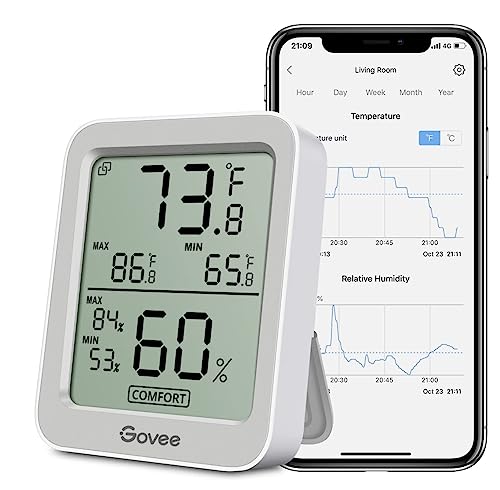
Govee Indoor Hygrometer Thermometer H5075 measures indoor temperature and humidity through a Bluetooth-connected sensor. Supplied product data does not describe radio frequency output, facial treatment, skin contact, thermal control, or cosmetic use.
That distinction changes every later comparison. A thermometer can report room conditions, but it cannot deliver RF energy, regulate treatment temperature, or replace a purpose-built skin device.
Look for Documented Temperature Control
Automatic temperature control should mean more than a display showing ambient conditions. Product documentation should explain how sensors monitor treatment-area temperature, how output changes, and what limits apply during use.
Without those details, “temperature control” can describe monitoring rather than regulation. Ask whether the device uses closed-loop feedback, user-selectable levels, timed shutoff, or warnings when contact becomes unsuitable.
Separate Monitoring From Treatment
The H5075 lists a Swiss-made hygrometer sensor, temperature accuracy of ±0.54°F, humidity accuracy of ±3%RH, and refresh speed up to two seconds. Those specifications may suit room monitoring, but they provide no evidence of cosmetic treatment performance.
A treatment device needs specifications tied to skin contact and energy delivery. Useful evidence includes operating frequency, treatment area, temperature range, contact requirements, session duration, and manufacturer safety instructions.
Assess Treatment Protocol
Real RF devices require a repeatable protocol covering preparation, conductive gel or serum compatibility, movement pattern, treatment zones, session frequency, and cleaning. Automatic control helps only when users can follow that protocol consistently.
Before buying, check whether instructions define suitable facial areas and excluded zones. Avoid assuming that a device designed for room measurement, body wellness, or another cosmetic technology transfers safely to facial RF use.
Check Comfort and Contact Design
Comfort depends on applicator shape, pressure, warmth, cable or battery design, treatment area, and how easily the device maintains skin contact. Temperature automation cannot compensate for awkward handling or poor coverage.
Look for clear instructions about movement speed and pressure rather than choosing solely by app features. A smaller applicator may improve precision around contours, while a larger head can shorten routine time if contact remains even.
Review Safety Boundaries
RF use may not suit every person or treatment area. Follow manufacturer contraindications, avoid use over compromised skin, and ask a qualified healthcare professional before use when pregnancy, implanted electronic devices, active skin conditions, recent procedures, or medication concerns apply.
Patch testing cannot establish that RF energy is appropriate, but it can help identify sensitivity to conductive gel or skincare products. Stop when discomfort, excessive heat, persistent redness, or another unexpected reaction appears, and seek professional advice when symptoms continue.
Calculate Ownership Value
Premium pricing earns its place when it improves repeat use through reliable controls, useful feedback, practical ergonomics, durable construction, and accessible support. It does not earn its place when an app distracts from missing treatment specifications.
Include conductive medium, replacement parts, charging equipment, warranty coverage, and cleaning requirements in ownership cost. For broader context, our luxury RF skin-tightening device guide explains where premium features can matter and where they may not.
Why You Should Trust Us
Our editorial method separates supplied product facts from interpretation, then checks whether each listed feature answers the searcher’s actual problem. We do not treat sensor accuracy, app connectivity, or consumer ratings as proof of RF treatment capability.
When evidence is incomplete, we narrow the recommendation instead of filling gaps with assumed specifications. Here, the available listing describes Govee Indoor Hygrometer Thermometer H5075, so we cannot responsibly present it as an RF beauty device.
Final Thoughts
Best overall choice among supplied data is none for facial RF treatment. Govee Indoor Hygrometer Thermometer H5075 has documented environmental-monitoring features, including app alerts, a large LCD, comfort indicators, and stored temperature and humidity history.
Its best specific use is indoor climate monitoring, not skin tightening. Our at-home RF guide for jowls offers a more relevant starting point for shoppers comparing facial treatment devices.
Best value cannot be assigned for this RF search because category fit comes before cost. If your goal is room monitoring, the supplied Govee listing matches that purpose; if your goal is facial RF, choose a product with documented energy delivery and temperature-management details.
FAQs
What is the top-rated option among best rf device with automatic temperature control in 2026?
The supplied listing cannot answer that question because Govee Indoor Hygrometer Thermometer H5075 is an indoor thermometer, not a documented RF skin device. A valid comparison needs confirmed RF output, treatment instructions, and temperature-control specifications.
Does the Govee Indoor Hygrometer Thermometer H5075 deliver radio frequency energy?
Supplied data describes temperature and humidity monitoring through a Swiss-made hygrometer sensor and Bluetooth app. It does not describe RF energy delivery or cosmetic treatment functionality.
What does automatic temperature control mean on an RF device?
It should describe feedback that monitors treatment conditions and adjusts output or limits operation according to documented thresholds. A display or room sensor alone does not prove automatic control of skin-treatment temperature.
Why does treatment temperature matter for at-home RF?
Temperature affects comfort, routine consistency, and the need to follow manufacturer instructions carefully. Users should never infer a safe operating range without product-specific documentation and professional guidance when relevant.
Can an indoor thermometer improve RF treatment safety?
An indoor thermometer may describe room conditions, but it does not measure treatment-area temperature or control RF output. It cannot substitute for integrated device safeguards.
What specifications should an RF buyer verify?
Verify operating frequency, treatment zones, temperature range, sensor behavior, session length, conductive-medium requirements, cleaning instructions, contraindications, warranty, and replacement costs. Missing details should lower confidence.
Should sensitive skin avoid at-home RF devices?
Suitability depends on individual circumstances and device instructions. Follow contraindications, patch-test compatible products, avoid compromised skin, and seek qualified professional advice when sensitivity or medical factors create uncertainty.
Where can I compare more relevant RF devices?
Compare purpose-built options through the RF and Skin Tightening category, then confirm every treatment and safety specification with current manufacturer documentation.
Evidence and safety references
These references support the general technology and safety context. Product specifications can change; confirm the current manual and regulatory status before use.
- Systematic review: radiofrequency-based facial rejuvenation
- Systematic review: home-based dermatology devices
- Randomized trial: home-use multi-energy facial device
Safety note: Beauty devices are not a substitute for diagnosis or treatment. Follow the device instructions and consult a qualified clinician if you have a skin condition, take photosensitizing medication, are pregnant, or are unsure whether a device is appropriate.