

Red light therapy for the body comes in three main formats. Panels cover large areas like the back or legs. Mats and pads wrap around or lie under the body. Belts strap onto one area, such as the lower back or knee. Most use red (around 660 nm) and near-infrared (around 850 nm) light.
Our pick: the Lifepro Bioheal Panel, with dual-chip LEDs and 4.7 stars from about 800 Amazon ratings at the time of writing. Best mat: the Comfytemp Red Light Therapy Mat, with about 970 ratings at 4.9 stars.

Pros
- Dual-chip LED technology
- Flexible placement options
- Lightweight and portable
- Includes hanging kit and eyewear
- Simple one-button operation
Cons
- Corded power source only
- Smaller panel size may limit coverage
- No battery or vibration setting
Specifications
| Product Dimensions | 10.2 x 8.8 x 3.4 inches; 5.5 pounds |
|---|---|
| Item model number | LP-BIOHL-BLK |
| Department | Unisex Adult |
| Date First Available | March 4, 2022 |
| Manufacturer | LifePro |
| ASIN | B09TWLZM9P |
| Best Sellers Rank | #97,830 in Health & Household (See Top 100 in Health & Household) #298 in Light Therapy Products |
| Customer Reviews | 4.5 4.5 out of 5 stars (803) |
Verify the current product variation before purchase; specifications may change.
Detailed Review
What stands out in the currently available product data:
- Dual-chip LEDs combine 660nm red and 850nm near-infrared for broad coverage
- Flexible placement: use standing, hanging on a door, or laying flat
- Three light modes and a 1-30 minute adjustable timer for customized sessions
- Irradiance of 203 mW/cm² at 3 inches for effective treatment
- Lightweight design at 5.5 pounds for easy portability
- Includes hanging kit and eyewear for immediate setup
Best For / Avoid If
Best for buyers prioritizing
- Dual-chip LED technology
- Flexible placement options
- Lightweight and portable
Consider another option if
- Corded power source only
- Smaller panel size may limit coverage
- No battery or vibration setting
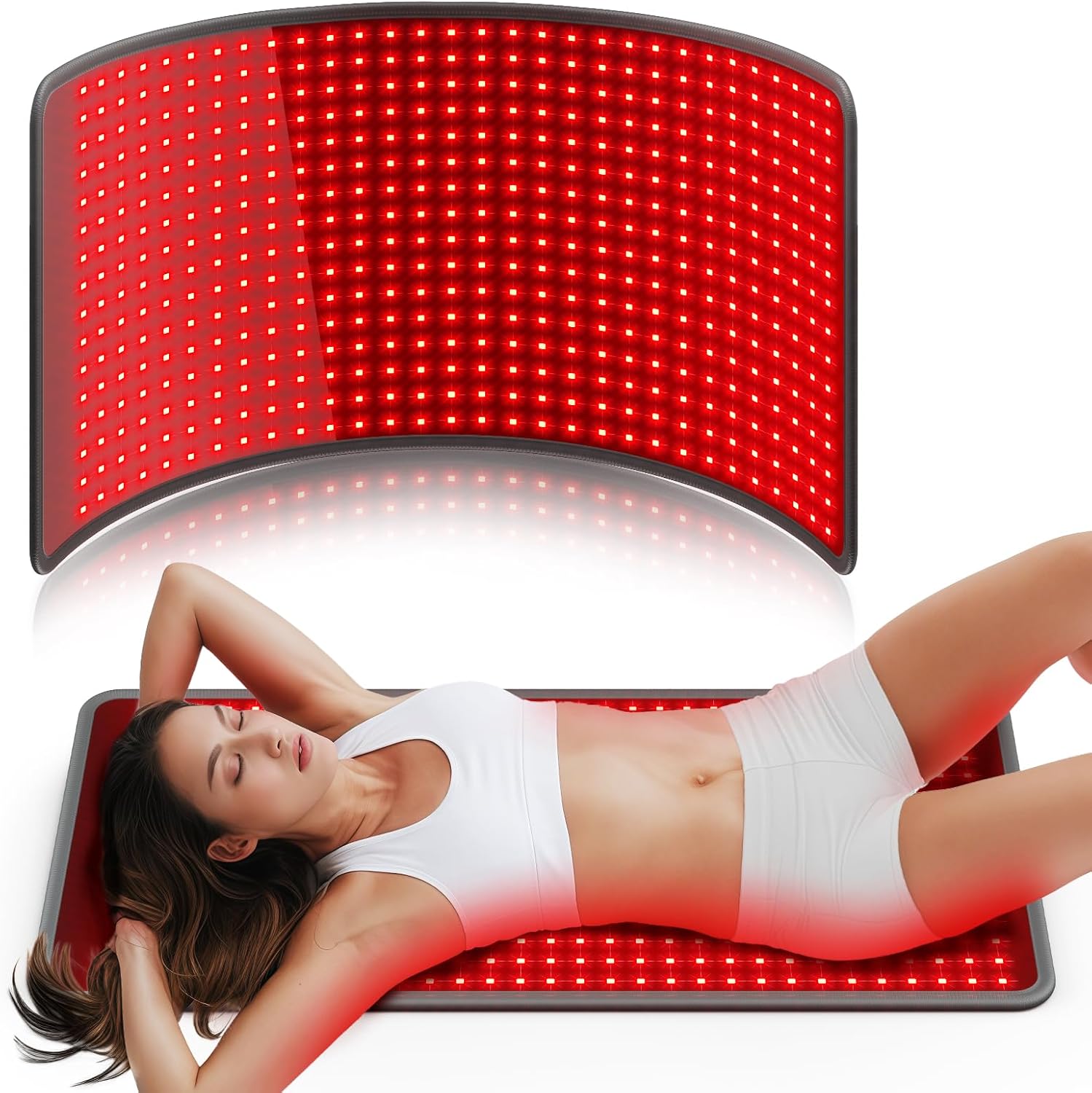
Pros
- Large coverage for back and joints
- Dual wavelength 660nm and 850nm
- Flexible and travel-friendly design
- Simple controls with auto-off timer
- Responsive customer service for defects
Cons
- LED rows may fail over time
- Fixed 20-minute auto-off timer
Specifications
| Package Dimensions | 17.72 x 8.11 x 4.09 inches; 3.06 pounds |
|---|---|
| Date First Available | July 11, 2025 |
| Manufacturer | Shenzhen Yicai Health Technology Co. , Ltd |
| ASIN | B0F1G19XVQ |
| Best Sellers Rank | #22,429 in Health & Household (See Top 100 in Health & Household) #13 in Light Therapy Products |
| Customer Reviews | 4.5 4.5 out of 5 stars (970) |
Verify the current product variation before purchase; specifications may change.
Detailed Review
What stands out in the currently available product data:
- Large 33x17 flexible pad covers the entire back, hips, and knees in one session
- 480 dual-wavelength LEDs combine 660nm red and 850nm near-infrared light
- Four modes and three intensity levels let you tailor every session
- Lightweight and packable design fits easily in luggage for travel
- One-button operation with a 20-minute auto-off timer for safety
- Flexible material wraps around joints or lies flat for versatile placement

Pros
- Dual wavelength 660nm and 850nm
- Four modes and three intensity levels
- 20 minute auto shutoff timer
- Corded power, no battery anxiety
- Lightweight and flexible wrap design
Cons
- Vinyl lining may feel less breathable
- Coverage area limited to 22 by 8 inches
- Corded design restricts movement
Specifications
| Product Dimensions | 50 x 8 x 1.5 inches; 1.46 pounds |
|---|---|
| Date First Available | March 1, 2024 |
| Manufacturer | Comfytemp |
| ASIN | B0D6GHY88X |
| Best Sellers Rank | #12,207 in Health & Household (See Top 100 in Health & Household) #6 in Light Therapy Products |
| Customer Reviews | 4.5 4.5 out of 5 stars (1,379) |
Verify the current product variation before purchase; specifications may change.
Detailed Review
What stands out in the currently available product data:
- 126 dual-chip LEDs emit both 660nm red and 850nm near infrared light
- Four modes and three intensity levels let you tailor each session
- 20 minute auto shutoff timer supports consistent, worry free use
- Corded design provides steady power without battery anxiety
- Flexible 50 by 8 inch wrap fits lower back, waist, legs, and more
- Lightweight 1.46 pound build is easy to wear while sitting or lying down
Best For / Avoid If
Best for buyers prioritizing
- Dual wavelength 660nm and 850nm
- Four modes and three intensity levels
- 20 minute auto shutoff timer
Consider another option if
- Vinyl lining may feel less breathable
- Coverage area limited to 22 by 8 inches
- Corded design restricts movement

Pros
- Lightweight hands-free wrap
- Dual red and infrared wavelengths
- Timer and five settings
- Versatile placement on body
- 60-day money-back policy
Cons
- Power bank not included
- Customer service can be slow
- Some durability concerns reported
Specifications
| Package Dimensions | 11.06 x 8.58 x 2.44 inches; 1.41 pounds |
|---|---|
| Item model number | US11412RIRBK |
| Date First Available | June 22, 2022 |
| Manufacturer | USUIE |
| ASIN | B0B4SB6FG1 |
| Best Sellers Rank | #15,640 in Health & Household (See Top 100 in Health & Household) #10 in Light Therapy Products |
| Customer Reviews | 4.4 4.4 out of 5 stars (2,278) |
Verify the current product variation before purchase; specifications may change.
Detailed Review
What stands out in the currently available product data:
- Dual 660nm red and 850nm infrared LEDs support at-home body light therapy sessions
- Hands-free 0.74 lb wrap lets you move around while treating back, waist, or shoulders
- Built-in timer and five settings help you manage session length and intensity
- Flexible Velcro design adapts to waist, thigh, shoulder, knee, and ankle
- Wall adapter and USB power cord offer outlet or power bank flexibility
- 60-day money-back policy makes at-home light therapy a lower-risk trial
Best For / Avoid If
Best for buyers prioritizing
- Lightweight hands-free wrap
- Dual red and infrared wavelengths
- Timer and five settings
Consider another option if
- Power bank not included
- Customer service can be slow
- Some durability concerns reported

Pros
- Affordable entry-level price
- Easy to assemble and adjust
- Includes protective glasses
- Stable stand for multiple angles
- Timer function for convenience
Cons
- No specific clinical evidence cited
- Limited to basic settings
- Build may feel basic long-term
Specifications
| Product Dimensions | 0.39 x 0.39 x 0.39 inches; 7.12 pounds |
|---|---|
| Item model number | Viconor |
| Date First Available | October 9, 2023 |
| Manufacturer | Viconor |
| ASIN | B0CJ2V41CC |
| Best Sellers Rank | #11,254 in Health & Household (See Top 100 in Health & Household) #4 in Light Therapy Products |
| Customer Reviews | 4.6 4.6 out of 5 stars (1,016) |
Verify the current product variation before purchase; specifications may change.
Detailed Review
What stands out in the currently available product data:
- Dual-wavelength therapy with 660nm red and 850nm near-infrared light for targeted skin and muscle benefits
- Adjustable stand and long power cord allow flexible positioning for use while sitting, lying, or reading
- Easy 1-2 minute assembly with a stable base and straightforward controls for daily routines
- Includes protective glasses and a timer function for convenient, hands-free sessions
- Wide coverage area suitable for both face and body treatments without needing separate devices
- Sturdy build and compact design that stores easily when not in use
Best For / Avoid If
Best for buyers prioritizing
- Affordable entry-level price
- Easy to assemble and adjust
- Includes protective glasses
Consider another option if
- No specific clinical evidence cited
- Limited to basic settings
- Build may feel basic long-term

Pros
- Dual wavelength for skin and deep tissue
- Detachable for portable or stand use
- Adjustable stand with 360-degree head
- Multiple timer and brightness settings
- Stable stand, no tipping risk
Cons
- Limited to 13x7.5 inch panel size
- No scientific evidence provided
- Not suitable for large body areas
Detailed Review
What stands out in the currently available product data:
- Dual-wavelength therapy with 660nm visible red light for skin and 850nm near-infrared for deeper tissue penetration
- Detachable 2-in-1 design allows handheld use with elastic strap or mounting on stand for full-body coverage
- Adjustable stand with 180-degree flip and 360-degree rotatable head for targeting any body area
- Five brightness levels and timer settings from 10 to 90 minutes for customized sessions
- Three working modes: constant light, 10Hz pulse, and 40Hz pulse for varied treatment options
- Quick setup without tools and stable aviation-grade aluminum stand prevents tipping
Best For / Avoid If
Best for buyers prioritizing
- Dual wavelength for skin and deep tissue
- Detachable for portable or stand use
- Adjustable stand with 360-degree head
Consider another option if
- Limited to 13x7.5 inch panel size
- No scientific evidence provided
- Not suitable for large body areas

Pros
- High power and irradiance
- Dual wavelength for deep and surface effects
- Adjustable timer with cooling fan
- Versatile mounting options included
- Affordable for a 300W panel
Cons
- No clinical evidence cited
- Limited to 0 reviews at launch
- Build quality not independently confirmed
Specifications
| Package Dimensions | 17.44 x 11.77 x 2.91 inches; 6.88 pounds |
|---|---|
| Date First Available | November 1, 2024 |
| Manufacturer | Viconor |
| ASIN | B0DLMSKJYM |
| Best Sellers Rank | #105,476 in Health & Household (See Top 100 in Health & Household) #329 in Light Therapy Products |
Verify the current product variation before purchase; specifications may change.
Detailed Review
What stands out in the currently available product data:
- Dual chip LEDs emit both 660nm red and 850nm near-infrared light for superficial and deep tissue penetration
- High 300W power with 140mW/cm² irradiance at 6 inches for efficient treatment sessions
- Built-in timer from 5 to 30 minutes with a cooling fan for safe, hands-off use
- Includes hanging kit, hooks, and eye protection for tabletop or wall mounting
- Designed for use on both body and face, with versatility for work, rest, or exercise
- Thoughtful gift for those seeking convenient at-home light therapy to complement natural sunlight
Best For / Avoid If
Best for buyers prioritizing
- High power and irradiance
- Dual wavelength for deep and surface effects
- Adjustable timer with cooling fan
Consider another option if
- No clinical evidence cited
- Limited to 0 reviews at launch
- Build quality not independently confirmed

Pros
- High output power for effective therapy
- Dual-chip LEDs for even light coverage
- Includes stand and hanging kit
- Modular for custom setups
- 3-year warranty
Cons
- Limited to 60 LEDs for partial body
- No full-body coverage in a single session
- Requires close proximity for treatment
Specifications
| Light Source Type | Light Emitting Diode |
|---|---|
| Power Source | Corded Electric |
| Light Source Wattage | 300 watts |
| Number of Light Sources | 60 |
| Beam Angle | 60 degrees |
| Wattage | 300 |
| Material Type | Iron |
| Item Weight | 4.3 kg |
| Item Dimensions L x W x H | 61.2"L x 15.7"W x 3.1"H |
| Color | Red |
Verify the current product variation before purchase; specifications may change.
Detailed Review
What stands out in the currently available product data:
- Dual-chip LEDs deliver both 660nm red and 850nm near-infrared light for balanced therapy in one session
- High irradiance over 100 mW/cm² for effective cellular stimulation
- Built-in digital timer and independent controls for precise session management
- Includes a table-top stand and door hanging kit for flexible placement
- Modular design allows expansion with additional PRO Series panels for larger setups
- Flicker-free LEDs with internal cooling fan for consistent, comfortable use
Best For / Avoid If
Best for buyers prioritizing
- High output power for effective therapy
- Dual-chip LEDs for even light coverage
- Includes stand and hanging kit
Consider another option if
- Limited to 60 LEDs for partial body
- No full-body coverage in a single session
- Requires close proximity for treatment
The Picks
- Best panel: Lifepro Bioheal. Use standing, sitting or lying down.
- Best mat: Comfytemp 33″x17″ Mat. Large coverage for back or legs.
- Best belt: Comfytemp Red Light Belt. 126 LEDs, about 1,400 ratings.
- Belt alternative: USUIE Red Light Belt. Hands-free, about 2,300 ratings.
- Budget lamp: Viconor Lamp with Stand. About 1,000 ratings.
- Lamp alternative: INTEO 660/850 nm Lamp.
- Bigger panels: Viconor 300W or Hooga PRO300.
Which Format?
| Format | Best for | Pros | Cons |
|---|---|---|---|
| Panel | Back, legs, full body | Covers large areas | Bulky |
| Mat or pad | Lying on, wrapping limbs | Comfortable, hands-free | Less intense |
| Belt | Lower back, knees, joints | Targeted, portable | Small area |
| Lamp | Spot use | Cheap, flexible | Small area |
How to Use It
- Follow the session time in the manual, often 10–20 minutes.
- Keep the distance the brand recommends for panels.
- Wear eye protection with bright panels.
- Use it several times a week; results build over weeks.
Safety
Avoid use over areas with skin cancer or suspicious moles, and ask a doctor first if you’re pregnant, take light-sensitizing medication or have a medical condition. Red light therapy isn’t a substitute for medical treatment of pain or injury.
For face devices, see the best LED light therapy device.
How We Chose
We compared formats, wavelengths, coverage, prices and Amazon rating data at the time of writing. We haven’t measured light output ourselves.
FAQs
Is a red light panel or mat better?
A panel is better for large areas; a mat is more comfortable for lying on.
How often should I use red light on my body?
Several times a week, following the manual.
Do red light belts work?
They deliver red and near-infrared light to a small area. Results vary.
Do I need goggles?
With bright panels, yes.
Evidence and safety references
These references support the general technology and safety context. Product specifications can change; confirm the current manual and regulatory status before use.
- Systematic review: evidence for home-based dermatology devices
- Umbrella review: photobiomodulation health outcomes
Safety note: Beauty devices are not a substitute for diagnosis or treatment. Follow the device instructions and consult a qualified clinician if you have a skin condition, take photosensitizing medication, are pregnant, or are unsure whether a device is appropriate.